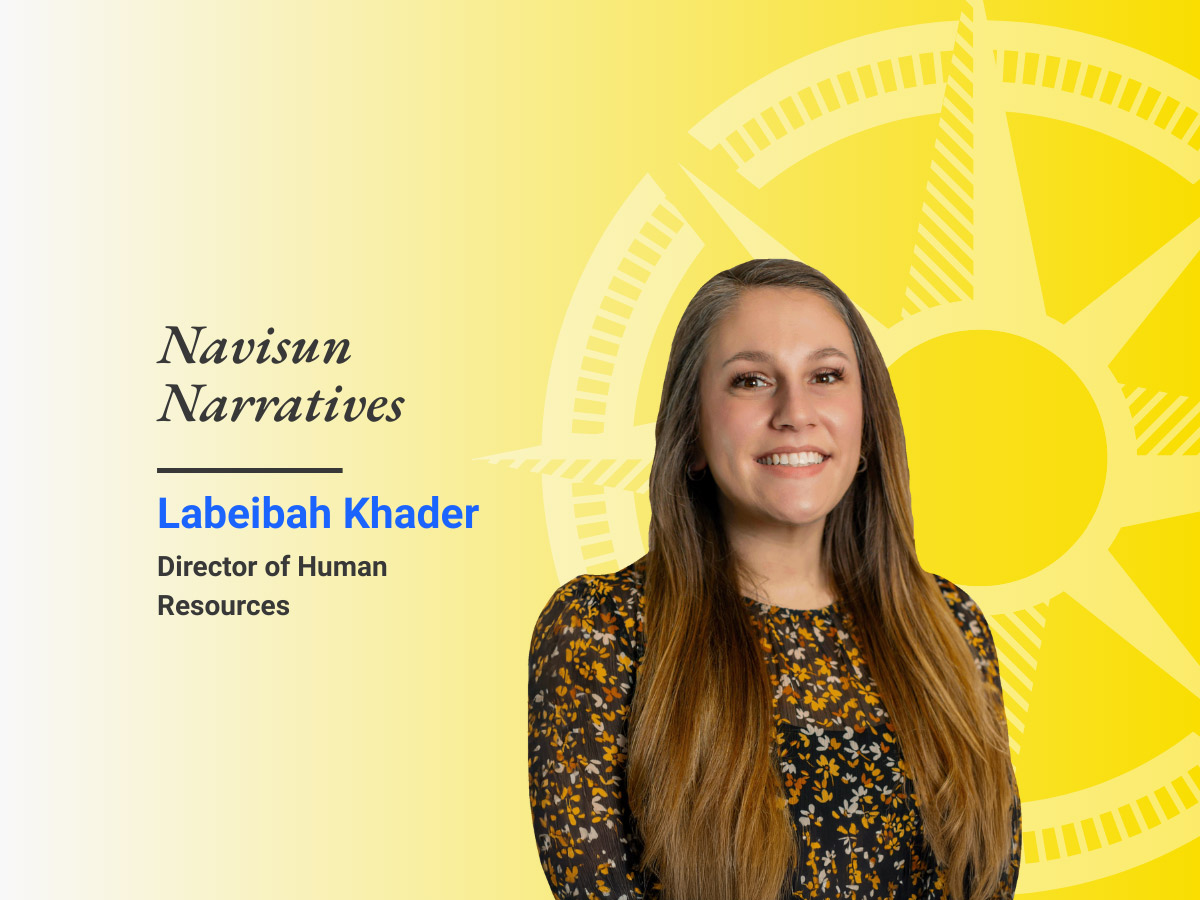
Navisun Narratives: Labeibah Khader, Director of Human Resources
At Navisun, our people are the foundation of every clean energy project we develop, own, and operate. Through our Navisun Narratives series, we highlight the individuals whose passion and expertise fuel our mission and shape a more sustainable future.
We recently sat down with Labeibah Khader, Director of Human Resources, to learn about her journey into HR leadership, her approach to building inclusive, high-performing teams, and how she’s helping cultivate a culture that supports Navisun’s growth and values.
Can you tell us about your path into human resources and what inspired you to pursue this career?
It was actually an accident. I started in psychology in college and quickly realized that a traditional research and publishing path wasn’t for me. I enjoyed the human interaction side of psychology much more, which led me to add business as a second major. Psychology and business naturally tie into organizational behavior, so I earned my master’s in organizational behavior at Suffolk University, which became the foundation of my HR career.
Career-wise, I explored many facets of HR and eventually became a well-rounded HR generalist. Even as an undergraduate, I worked as a recruiter for the honors program and handled admissions and scholarships — work I still support today through Salem State’s scholarship assessment committee.
From there, I moved through roles that each shaped my understanding of people and operations. At Avis Budget Group, I managed a large airport team and learned how training, metrics, and performance systems impact both employee and customer experience. Later, I spent time in financial services, gaining insight into how benefits and retirement planning truly affect people’s lives.
My HR philosophy fully came together at a B2B wholesaler, where I was initially hired as a bookkeeper. Due to staffing changes, I took on HR responsibilities and ultimately built the HR function from the ground up as the company doubled in size. I overhauled benefits, payroll, retirement plans, and HR systems so the organization could scale.
The biggest lesson there came from working with a highly diverse workforce. I learned how important accessibility and compassion are in HR—sometimes that meant sitting in the warehouse explaining benefits one-on-one so people truly understood them.
People are often scared of HR, but companies succeed because of the people who work there. That belief has guided me ever since.
After five years, I had built everything I could there. When a recruiter reached out about Navisun — then a 14-person company — I saw another opportunity to build something meaningful. One of my first projects was rewriting the employee handbook and laying the foundation for scalable growth.
How did earning your MBA from Suffolk University shape your approach to leadership and strategic HR management?
One of my professors taught conflict resolution and negotiation, and his core lesson was simple: you already know your goal — your job is to understand the other person’s.
He used to say, “That’s a symptom. Peel the onion. What’s the actual sickness?”
That lesson stuck with me. Most workplace issues aren’t the real problem — they’re symptoms. I learned to listen carefully, identify patterns, and dig down to the root cause. Sustainable resolution only comes from understanding the underlying breakdown, not reacting to surface-level frustration.
What drew you to Navisun and to the renewable energy sector more broadly?
I’m less motivated by industry and more by learning and growth. I enjoy being challenged and constantly developing new skills.
When I first joined Navisun, everything sounded like alphabet soup. I remember calling my mom on day one and saying, “I’ve made a huge mistake.” But the team was incredibly supportive, and I picked it up quickly.
I’ve worked in finance, rental services, and wholesale distribution. Each industry added a new layer to my experience, and renewable energy felt like the next exciting challenge.
How do you see HR’s role in supporting Navisun’s mission to create sustainable energy solutions?
My role is to make sure our people have every tool and resource they need to succeed — professionally and personally.
That includes staffing, development plans, benefits, infrastructure, and balance. I advocate for those needs, mentor our leadership team, and help create an engaging environment that attracts and retains great talent.
The work our team does is incredible. I may not build solar projects, but I support the people who do — and that’s how I contribute to our mission.
What excited you most about the opportunity to build and guide Navisun’s people strategy?
Navisun was small and growing, which meant opportunity. I quickly saw areas where my experience could strengthen systems, benefits, onboarding, and structure.
I’ve also been fortunate to build a strong partnership with leadership. Ideas are welcomed, and decisions are driven by thoughtful business cases rather than automatic “no’s.” That level of trust and support makes it possible to see real change and real impact.
How would you describe your leadership style, and how has it evolved throughout your career?
Earlier in my career, I tried to fix everything immediately. Over time, I realized that constantly putting out fires doesn’t address the root cause.
Now, I focus on understanding why something is happening. That means active listening, summarizing what I hear, and ensuring clarity — sometimes even following up in writing so everyone is aligned.
It’s similar to therapy in that you’re distinguishing symptoms from causes. I still hear my professor’s voice asking, “What’s the disease?”
In what ways do you apply the business and analytical skills from your MBA to HR decision-making at Navisun?
Foundationally, everything is like a case study. If you approach a situation analytically, you can delve into core issues instead of symptoms.
You can read about this stuff all you want, but really it’s life experience. You learn to view things as a case study and take a step back, but figuring out what to do comes from time, mistakes, watching others make mistakes.
I also have a SHRM-SCP and that also brings along a global, holistic enterprise level of strategic thinking.
School was a long time ago, to be honest, but you work with strangers, learn to synthesize information, get projects done, and not be reactive. All of that shapes how I approach HR today.
How do you balance data-driven HR with the human side of leadership?
We use data to guide strategic decisions, not to be punitive. Performance data helps us identify development opportunities. Benefits data helps us enhance offerings. Market data keeps us competitive.
But data also comes from conversations and understanding people’s interests, goals, and growth areas. All forms of data help ensure our employees walk away stronger and more supported.
What defines Navisun’s company culture, in your view, and how do you help nurture it?
We’re united by sustainability, community impact, and collaboration. Face-to-face connection matters here, which is why hybrid work and in-person events are so important.
Our QBRs, volunteer days, and site visits bring people together across teams and roles. They build relationships, trust, and accessibility. I want HR to feel supportive, not intimidating.
As our CEO Jason says, developing people so well that they outgrow you means you’ve done your job. I feel the same — helping others shine is how I measure success.
What initiatives or programs have you implemented to support professional development or diversity and inclusion?
We’ve been incorporating training into each QBR. This year, the focus was hard skills and systems. Next year, I want to dive more into soft skills.
Everyone gets the opportunity to do a development plan. Sometimes the needs are departmental, sometimes across the board, but often it’s 1:1 with managers. Stretch assignments are huge here. When people raise their hand to grow, they get projects outside their wheelhouse to get that direct support and develop quickly.
For diversity, we always want the best candidate. We work with recruiters to ensure we’re tapping into diverse applicant pools. If we see a slate that looks too homogenous, that’s a red flag and we push for more diversity.
As far as solar companies go, we’re definitely above the industry and regional standards for male-to-female ratio, especially in leadership.
Can you share a project or achievement at Navisun that you’re particularly proud of?
What excites me most is seeing people thrive when their skills, interests, and opportunities align. Sometimes roles aren’t obvious on paper, and creativity makes all the difference.
Recently, we worked with an employee exploring a career change. By understanding what energized her and where she wanted to grow, we shaped a role that fit — and she’s thriving. Seeing that kind of impact is incredibly rewarding.
What’s your vision for HR at Navisun?
Accessibility and partnership. HR shouldn’t feel like a barrier — it should feel like support.
I work closely with managers and employees at every career stage, helping them map out growth paths and discover what they’re passionate about. When people are engaged and developing, the business grows too.
What philosophy guides you professionally and personally?
“Peel the onion.”
Whenever something feels like a problem, I pause and ask what’s really underneath. It’s the only way to create lasting solutions.
How do you stay inspired outside of work?
I’m a mother of three, and they center my life. Compassion and community matter deeply to me — both at home and at work.
I also prioritize staying active. Powerlifting, kickboxing, and time with friends help me recharge. That balance keeps me grounded and energized.
What’s something about you that your colleagues might be surprised to learn?
I’m a dual citizen of Jordan and the U.S. My name, Labeibah, comes from an old Arabic word meaning “smart.” I’m not mad about that at all.