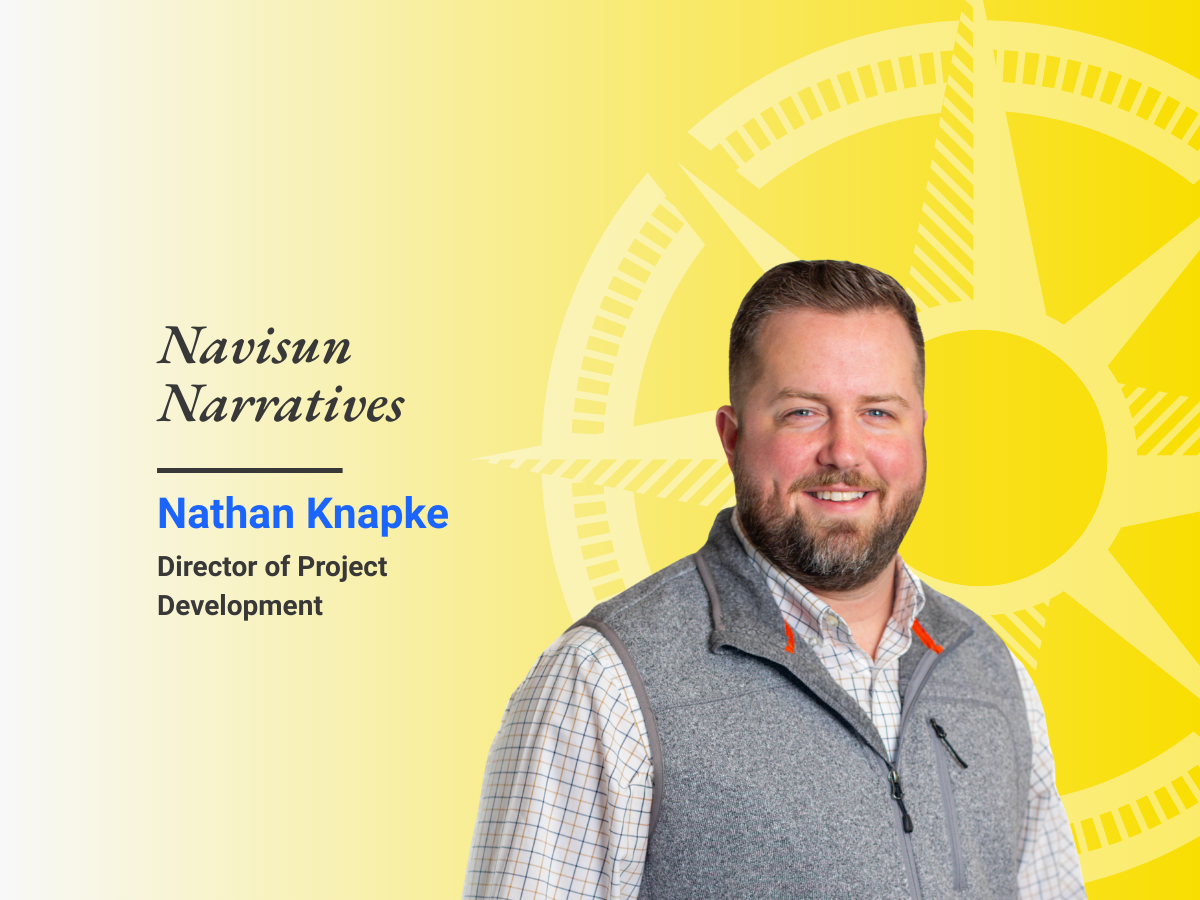
Navisun Narratives: Nathan Knapke, Director of Project Development
At Navisun, our people are the foundation of every clean energy project we develop, own, and operate. Through our Navisun Narratives series, we highlight the individuals whose passion and expertise fuel our mission and shape a more sustainable future.
We recently sat down with Nathan Knapke, Director of Project Development, to learn about his journey into solar, his approach to leadership, and what it really takes to move a project from concept to construction.
Can you tell us a bit about yourself to get started?
I spent most of my youth in Ohio, and I’ve always felt connected to open landscapes and the communities that define the Midwest. After high school, I joined the U.S. Marine Corps—partly to serve, and partly to figure out what I wanted to do with my life.
In the Marines, I worked in public affairs as a journalist. I was stationed in Hawaii, covering training operations, and I spent time in the Pacific, including a trip to Tonga. It wasn’t glamorous work, but it gave me perspective, and it taught me a lot about people and leadership.
Outside of the job, Hawaii is where I really got into sailing. I met people with sailboats, and a lot of them always wanted help operating or crewing. I spent a ton of time on the water and honestly, that’s where renewable energy started to click for me. One thing that always blew my mind: you’d be on a sailboat—literally harnessing wind power—and then you’d go down into the cabin and it would smell like diesel. And I kept thinking, why are we burning fuel when the sun is hitting the sails all day long?
That idea stuck with me. It pushed me to pursue an Electrical Engineering degree after my enlistment. I moved back to Toledo, finished school, and then got into the solar industry pretty much right away.
What originally drew you to energy—and what eventually pulled you into solar project development?
I tell people this all the time: I try to keep politics out of it, because I think it ruins our industry. For me, solar is exciting because the technology itself is incredible.
The simple fact that you can put a piece of glass out in a field and it just sits there producing electricity is wild. It’s glass and metal. It doesn’t really do anything. You just make sure the sun hits it, and it produces power.
I originally started as a project engineer for an EPC, and we didn’t always have jobs lined up. So we’d develop behind-the-meter C&I projects to create our own work—things where you still have to do interconnection applications, permitting, and a lot of the same steps you deal with in development.
At one point, my boss said, “There’s community solar in New York. Why don’t you see what you can figure out and how we can participate?” So I did. We developed projects in New York and Illinois, and we eventually sold them. It was a bit of luck, honestly, but once I got into it, I realized it fit me.
How did the Marine Corps share your leadership style?
One thing I liked about the Marines is that it shows you what you don’t want to be. There are good and bad leaders everywhere. I learned you can pick and choose what you respect in different people and try to emulate that. And in a lot of cases, I saw things I swore I’d never do.
Overall, I think if you have a good moral foundation, your leadership tends to follow. Don’t be a jerk. Focus on getting things done. Treat people right. That usually goes a long way.
What’s a “typical day” like for you at Navisun?
A “typical day” for me is really about progressing projects through the pipeline. That means monitoring the interconnection process, working with our third-party engineers to get through engineering items needed for permitting (local and state), and spending a lot of time on real estate and title work because there’s always something to resolve.
I really enjoy the interconnection strategy side. And I like the people side too. I feel like I can talk to anybody. I’ve sat at kitchen tables with farmers, answered hard questions, and driven around back roads with people I just met. You’ve got to be open and able to connect with people.
What makes the role a great fit for me is that I get both: the human side and the technical side.
And I get to work with a really diverse group, from finance and engineering (civil and electrical) to legal (contracts and title) and project management. I get my hands in a little bit of everything. I’m kind of a utility player but over time I feel like I’m getting more seasoned across all the areas that matter in solar development. I’m grateful Navisun has given me the opportunity to build on those skills.
What’s the most challenging part of getting a project from concept to reality right now?
The most challenging part of getting a project from concept to reality right now is interconnection and, depending on the project, real estate constraints can be just as intense.
In the Midwest, permitting usually isn’t the biggest roadblock compared to other regions, but interconnection and real estate can be eye-opening. On one project, we had a pipeline company with a blanket easement and an active pipeline running along the west side. We needed our access road to cross over their pipeline, and negotiating that took about a year.
We also had a utility basically say they had no way—real estate-wise—to get their lines onto our property. We had to negotiate a joint-use agreement with a local co-op so they could use another utility’s infrastructure to make it work.
But we pushed through. We got releases on blanket easements, secured crossing agreements, and got the project to NTP. That’s the work—finding a way forward through a lot of “no.”
Where do you see the biggest opportunities in distributed generation over the next 2–3 years?
Over the next few years, I see the biggest opportunities in states with high energy rates and a community solar program. Those programs create a runway, and not every state has that.
I’m hoping Ohio opens up more. There’s movement, but it’s still working its way through Columbus. I also think there’s huge potential in the Midwest overall: a lot of flat space, a lot of farmland, and communities that can directly benefit.
How does your work directly support Navisun’s mission and the communities where we build?
To me, distributed generation matters because we’re placing load where it’s needed. We’re not transmitting energy from hundreds of miles away; we’re building power closer to where it’s used.
And one of the biggest things people don’t always talk about is that DG helps spread the wealth. With centralized generation, you have one major site, one landowner, and a lot of value concentrated in one place. With solar (and wind too), we’re leasing land from people all over. It distributes the economic benefit across many landowners and communities.
No one is getting “rich,” but it can be life-changing. Lease income can help someone keep land in the family, stay afloat, or retire a little more comfortably. There’s also local investment, some tax revenue, and lower energy costs. It decentralizes power generation and it decentralizes who benefits from it.
Can you share a project or achievement at Navisun that you’re particularly proud of?
Projects like Norris City and Murphysboro stand out for me.
At the end of the day, you build real relationships with landowners. They place a lot of trust in you and they have plenty of other options. Some of these folks are doing everything they can just to keep their farms running. So you want to do right by them.
When a project gets to NTP, it’s a great feeling, not just internally, but for the landowner too. It shows they made the right choice working with us, and that we followed through. That’s the most gratifying part.
What makes collaboration work best at Navisun?
Collaboration works best when there are open lines of communication that are both formal and informal. Everyone has a specialty, and if you don’t create ways for people to share what they’re seeing, teams get siloed.
At the end of the day, we all want the best project outcome. And if you have strong internal expertise but never tap into it, you lose a lot of value.
What’s one lesson you’ve learned in development that you wish you’d known earlier?
Start the real estate process earlier. Start working through title issues and exceptions much earlier than you think you need to.
Outside the office: what’s your ideal day?
My ideal day is pretty simple: about 76 degrees, no humidity. I wake up, mow the lawn, watch the Buckeyes play football at noon, spend the afternoon on the boat with my wife and kids, and then come home and eat smoked meat for dinner.